Doom: Dark Ages Emulates Halo Leap
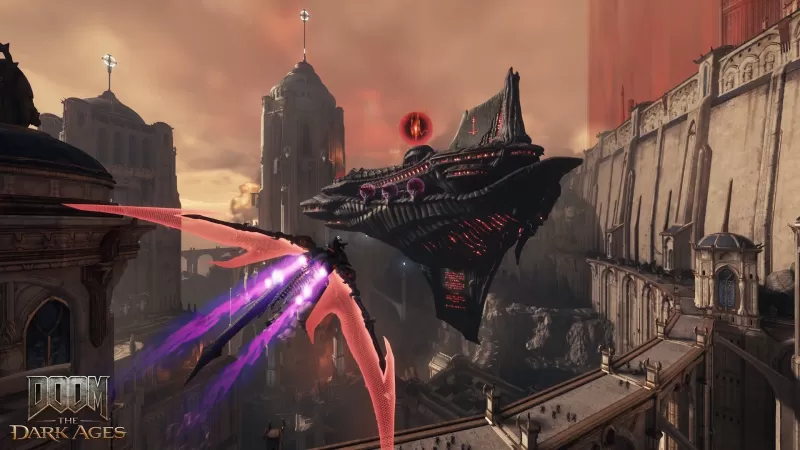
The last thing I expected from Doom: The Dark Ages was a reminder of Halo 3. Yet, halfway through a recent hands-on session with id Software's gothic prequel, I found myself mounted on a cyborg dragon, unleashing a torrent of machinegun fire against a demonic battle barge. After demolishing its defensive turrets, I landed the beast atop the vessel and stormed its lower decks, reducing the entire crew to a bloody pulp. Moments later, the war machine was finished, and I burst through its hull, leaping back onto my dragon to continue the crusade against Hell's armies.
Fans of Bungie's landmark Xbox 360 shooter will instantly recognize the parallels to Master Chief's assault on Covenant scarab tanks. While the helicopter-like Hornet is swapped for a holographic-winged dragon and the laser-firing mech for an occult flying ship, the core experience remains: an aerial assault that transitions into a devastating boarding action. Surprisingly, this wasn't the only moment in the demo that evoked Halo. While The Dark Ages' combat is unmistakably Doom, the campaign's design channels a distinct "late-2000s shooter" vibe, thanks to its elaborate cutscenes and a strong push for gameplay novelty.
Over two and a half hours, I played four levels of Doom: The Dark Ages. Only the first, the campaign opener, resembled the tightly paced, expertly crafted design of Doom (2016) and its sequel. The others had me piloting a colossal mech, flying the aforementioned dragon, and exploring a wide-open battlefield filled with secrets and powerful minibosses. This is a significant departure from Doom's usual focus on mechanical purity, feeling more akin to Halo, Call of Duty, or even old James Bond games like Nightfire—titles that thrive on scripted set-pieces and novelty mechanics that feature for a mission or two.
This direction is fascinating for Doom, a series that once made a definitive U-turn away from such concepts. The canceled Doom 4 was reportedly styled after Call of Duty, not just in its modern military aesthetic but also in its emphasis on characters, cinematic storytelling, and scripted events. After years of development, id Software concluded these ideas didn't fit the series, scrapping them for the more focused Doom (2016). Yet, in 2025, they reemerge in The Dark Ages.
The campaign's rapid pace is punctuated with new gameplay ideas reminiscent of Call of Duty's biggest novelties.“
My demo began with a lengthy, detailed cutscene reintroducing the realm of Argent D'Nur, the opulent Maykrs, and the Night Sentinels—the knightly brethren of the Doom Slayer. The Slayer himself is portrayed as a terrifying legend, a walking nuclear-level threat. While this lore will be familiar to dedicated fans who have studied the previous games' codex entries, the deeply cinematic presentation feels new, different, and very Halo-like. This extends into the levels, with NPC Night Sentinels scattered about the environment, similar to UNSC Marines. While they didn't fight alongside me (at least in the levels I played), there's a stronger sense you are the spearhead of a larger army—like Master Chief, you are the invincible tip of the spear.
The introductory cutscene invests heavily in character, and it remains to be seen if Doom truly needs this. I'm a fan of the prior games' subtle storytelling through environments and codex entries, reserving cinematics for major reveals, as in Eternal. While I have my reservations, the cutscenes thankfully know their place: they set up a mission and then step aside, never interrupting Doom's signature intense flow.
Interruptions come in other forms, however. After that opening mission—which starts with pure shotgun carnage and ends with parrying Hell Knights using the Slayer's new shield—I was thrust into the cockpit of a Pacific Rim-style Atlan mech to wrestle demonic kaiju. Later, I soared on the cybernetic dragon, destroying battle barges and gun emplacements. These tightly scripted levels create a significant gear shift, punctuating the campaign's rapid pace with new ideas reminiscent of Call of Duty's most memorable novelties, like Modern Warfare's AC-130 gunship sequence. The Atlan is slow and heavy, making Hell's armies look like Warhammer miniatures from its skyscraper-high perspective. The dragon, in contrast, is fast and agile, and the shift to a wide-angle third-person camera creates an experience that feels worlds apart from classic Doom.
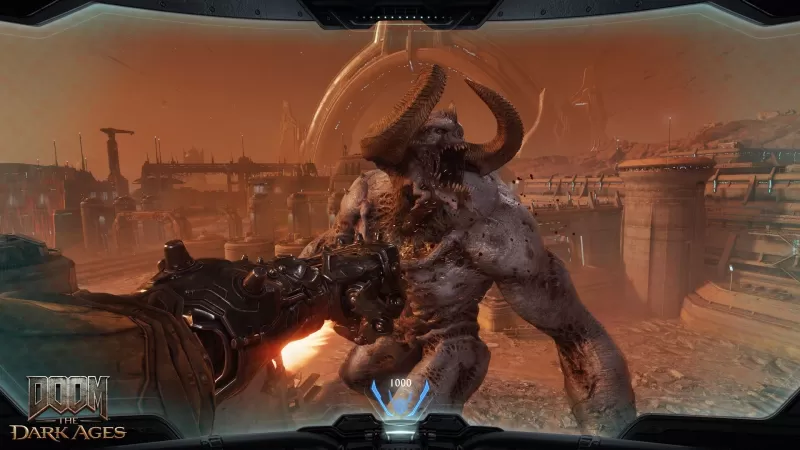
Many of the best FPS campaigns thrive on this kind of variety. Half-Life 2 and Titanfall 2 are the gold standard. Halo's longevity is partly due to its rich texture from mixing vehicular and on-foot sequences. But I'm unsure if this will work for Doom. Like Eternal, The Dark Ages is a wonderfully complex shooter demanding your full attention every second as you weave together shots, shield tosses, parries, and brutal melee combos. In comparison, the mech and dragon sequences feel anemic, stripped back, and almost on-rails—their combat engagements are so tightly controlled they border on QTEs.
In Call of Duty, switching to a tank or gunship works because the mechanical complexity isn't far from the on-foot missions. But in The Dark Ages, there's a clear gulf between gameplay styles, akin to a middle school guitarist playing alongside Eddie Van Halen. While Doom's core combat will always be the star, when I'm pummeling a giant demon with a rocket-powered mech punch, I shouldn't be wishing I was back on the ground with a "mere" double-barrelled shotgun.
My final hour of play saw The Dark Ages shift into another unusual guise, but one built on a much sturdier foundation. "Siege" refocuses on id's best-in-class gunplay but opens up Doom's typically claustrophobic level design into a vast open battlefield. Its geography shifts between narrow and wide, offering myriad pathways and combat arenas. The goal of destroying five Gore Portals has the same energy as Call of Duty's multi-objective missions, but I was reminded again of Halo—the grand scale of this map versus the tighter routes of the opening level evokes the contrast between Halo's interior and exterior environments. Here, the novelty is that the excellent core shooter systems are given new context in much larger spaces. You must reconsider the effective range of every weapon. Your charge attack covers football-field distances. And the shield deflects artillery fire from oversized tank cannons.
Were these ideas always a bad idea for Doom, or were they just a bad idea when they looked too much like Call of Duty?“
The downside of expanding Doom's playspace is that things can become a little unfocused. I found myself backtracking through empty pathways, which kills the pace. Here, I wish The Dark Ages had leaned even closer to Halo by integrating the dragon like a Banshee—being able to fly across the battlefield, raining down fire before divebombing into a miniboss fight would have maintained momentum and made the dragon feel more integral. If such a level exists beyond what I've seen, I'll be very pleased.
Regardless of the full campaign's structure, I'm fascinated that so much of what I've seen feels like a resurrection and reinterpretation of ideas once considered ill-fitting for the series. Very little of the canceled Doom 4 was publicly released, but a 2013 Kotaku report paints a clear picture. "There were a lot of scripted set pieces," a source stated, including an "obligatory vehicle scene." That's precisely what we have in the Atlan and dragon sections—mechanically simple scripted sequences reminiscent of novelty vehicle levels from Xbox 360-era shooters.
In a 2016 interview with Noclip, id Software's Marty Stratton confirmed Doom 4 "was much closer to something like [Call of Duty]. A lot more cinematic, a lot more story to it. A lot more characters around you." All that was scrapped, making its return in The Dark Ages genuinely fascinating. This campaign features big boarding action set-pieces, lush cinematics, a wider cast, and major lore reveals.
The question now is: were those ideas always unsuitable for Doom, or were they only problematic when they too closely resembled Call of Duty? Part of me shares the skepticism of fans who once decried "Call of Doom," but I'm also excited by the possibility of id Software finally making that approach work by grafting it onto the now-proven modern Doom formula.
The beating, gory heart of The Dark Ages unquestionably remains its on-foot, gun-in-hand combat. Nothing in this demo suggested it won't be front and center, and everything I played confirms it's another fantastic reinvention of Doom's core. I believe that alone is strong enough to carry an entire campaign, but id Software clearly has other plans. I'm surprised some of the studio's new ideas feel mechanically slim, and I worry they may feel more like contaminants than fresh air. But there's much more to see, and only time will contextualize these demo missions. I eagerly await May 15th, not just to return to id's unmatched gunplay, but to satisfy my curiosity: Is Doom: The Dark Ages a great late-2000s FPS campaign or a messy one?
- ◇ Rust Mobile Beta Set for 2024 Launch Jan 05,2026
- ◇ "Carey Mulligan Joins Cast of Barbie Director's Narnia Reboot" May 25,2025
- ◇ Jump King's 2D Platformer Hits Mobile Worldwide with Expansions May 23,2025
- ◇ Nintendo App Reveals Legend of Zelda Movie Release Date May 20,2025
- ◇ Eterspire Introduces Sorcerer Class May 18,2025
- ◇ 9th Dawn Revamp Hits Mobile in May Dec 24,2025
- ◇ "Amazon's BOGO 50% Off Sale Includes Batman: The Killing Joke Deluxe Edition" May 13,2025
- ◇ Crazy Games and Photon Kick Off 10-Day Global Web Multiplayer Jam 2025 May 08,2025











![Zenless Zone Zero [ZZZ] Codes (December 2024) – 1.4 Livestream Codes](https://imgs.96xs.com/uploads/54/1735628542677396feeb34f.jpg)

- 1 WWE 2K24 Update 1.11 Released Nov 10,2024
- 2 Capcom Spotlight February 2025 and Monster Hunter Wilds Showcase: Everything Announced Mar 05,2025
- 3 New LEGO Sets for March 2025: Bluey, Harry Potter, and More Mar 06,2025
- 4 PUBG Mobile Redeem Codes for January 2025 Live Now Feb 13,2025
- 5 Gothic 1 Remake Demo: Frame-by-Frame Comparison with Original May 01,2025
- 6 "Assassin's Creed Shadows Unveils Canon Mode" Apr 26,2025
- 7 Roblox's RNG War TD Codes Unleashed (2025 Update) Feb 12,2025
- 8 Pokémon TCG Pocket Unveils Premium Pass and Trade Tokens Apr 21,2025




![Business of Loving [v0.12.5i] [Dead End Draws]](https://imgs.96xs.com/uploads/18/1719555107667e5423ef803.jpg)
-
Top Business Management Apps for Android
A total of 10
-
Best Racing Games to Play Now
A total of 10
-
Best Competitive Multiplayer Games on Android
A total of 10